
This turkey delivers a great ROI just like InGo for your events.
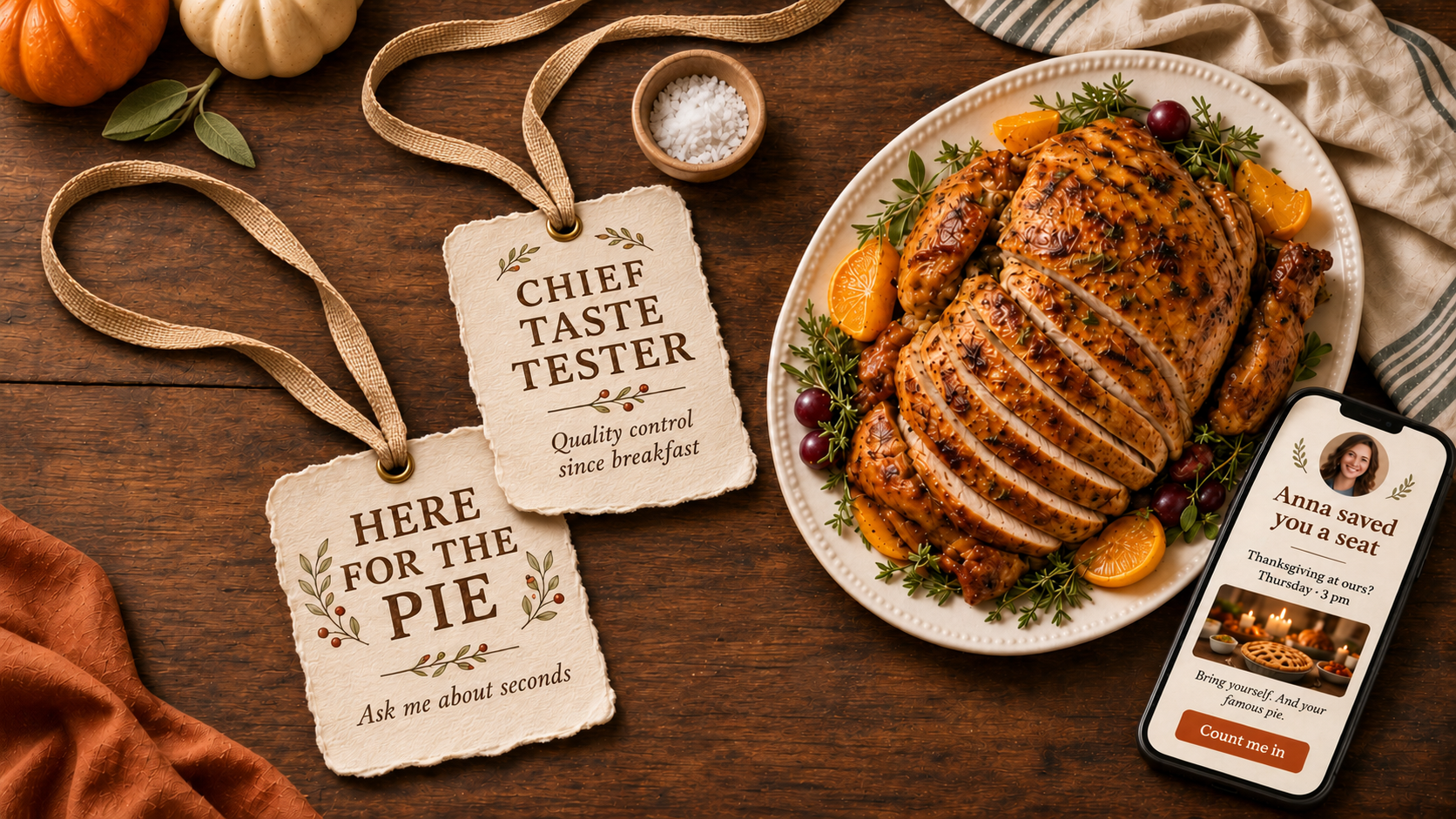
A Thanksgiving Recipe for Event Promotion
A great turkey is decided days before the oven goes on. A frozen bird needs a day in the fridge for every four pounds to thaw. Salting takes another 24 to 48 hours, and the skin needs time uncovered in the fridge to dry so it crisps. If you start on Thursday morning, no amount of oven time can make up for it.
Event promotion works the same way. If you want attendees to spread the word, give them an invitation worth sharing early, and more than one chance to share it.
Here's InGo's recipe, with prep you can do now and finishing touches for later.
Hungry for the real thing? There’s an actual recipe at the end.
Now, salt early
The Bird: Salting works slowly, which is exactly why it works. Given a day or two, the salt draws in and seasons the meat all the way through. Brining an hour before dinner doesn't do the same job.
Your Event: Advocacy builds the same way. The best time to ask someone to share is right after they've decided your event deserves a place on their calendar. Set up your InGo install so every registrant gets that chance at the moment of registration. Then plan your VIP Notifications to bring them back as the event gets closer. That gives you two steps in one recipe: an early start, then a timely return.
Pick a bird that fits the pan
The Bird: Bigger isn't better. A 12 to 14 pound turkey cooks more evenly than a giant one, and it's sure to fit in the oven.
Your Event: Your sharing graphic has the same problem. One clear visual, a readable event name, and only the details someone needs to understand the invitation. Preview it at the size it will actually appear in a social feed. If you have to squint, cut something.
Read the label
The Bird: Skip "enhanced" birds and look for an ingredient list that says only "turkey." Injected solutions add water weight and can leave the meat spongy.
Your Event: Suggested post copy can get puffed up the same way. Give it one honest job: help attendees tell their network why they're going and invite people to join them. A sentence that sounds like your attendee will travel further than one that sounds like a press release.
Put it where guests can see it
The Bird: Carve in the kitchen and bring out a platter, so the best part is right in front of everyone.
Your Event: Give your Social Surface the same treatment. Put it above the fold, where attendees see it without scrolling, and make the invitation to share easy to spot and easy to understand. Then check it on a phone. What looks prominent on your desktop may sit several swipes down on a smaller screen.
Later: Don't keep opening the oven
The Bird: Basting doesn't make a turkey juicier, which surprises a lot of people. It softens the skin, and every time the oven door opens the temperature drops and cooking slows down.
Your Event: As your event gets closer, ask attendees to share more than once, but make every ask count. Give each one its own space. A request buried under the agenda, travel details, and six other announcements is easy to miss. Give people a fresh reason to post, like a newly announced session, a speaker they're excited about, or the chance to meet colleagues. Use your VIP Notifications to keep that rhythm, and keep the invitation clear each time.
Take the temperature in the right spot
The Bird: Throw out the pop-up timer and use an instant-read thermometer. The lean breast and the richer dark meat finish at different temperatures, so check the breast and the thigh, not just one spot. A single reading won't tell you the whole story.
Your Event: Measure your campaign the same way. For social advocacy, start with what it's meant to produce. How many attendees shared? How many clicks did those posts bring? Then check what happens after the click. Your registration page is where visitors decide whether to sign up. Does it make the event's value clear? Is the register button easy to find? Is the next step simple?
Shares, clicks, and registrations are one journey. Taking a reading at each step shows you which part of the recipe needs adjusting.
Let it rest before you serve
The Bird: A turkey needs 30 to 45 minutes of rest before carving. Use that time on your campaign. Proofread the event name, dates, links, suggested post, and graphic. Send yourself a preview, and ask a colleague to read it fresh. A beautiful invitation with the wrong date is the promotional version of forgetting the salt.
Your Event: A memorable event campaign takes early prep, a few well-timed asks, and attention to the details your guests will notice. Start early, keep the recipe simple, and give attendees something they'll be proud to pass around.
Hungry for the real thing? Try this:
Juiciest Roast Turkey
Serves 10 to 12. Total time is 2½ hours, plus 24 hours 30 minutes for salting and resting.
Ingredients
- ¼ cup kosher salt
- 4 teaspoons sugar
- 1 (12- to 14-pound) turkey, trimmed, neck and giblets removed and reserved for gravy
Before You Begin
Note that this recipe requires refrigerating the seasoned bird for 24 to 48 hours. We developed this recipe with Diamond Crystal kosher salt. If you're using Morton kosher salt, which is denser, reduce the salt in step 1 to 3 tablespoons: Rub 1 tablespoon of the salt mixture into each side of the breast, 1½ teaspoons into each leg, and the remainder into the cavity. If using a self-basting turkey (such as a Butterball) or a kosher turkey, reduce the salt mixture by half. Serve the turkey with the strained drippings or reserve them for gravy.
Instructions
- Combine ¼ cup kosher salt and 4 teaspoons sugar in bowl. Place 1 turkey, trimmed, neck and giblets removed and reserved for gravy, breast side up on wire rack set in rimmed baking sheet and, using your fingers, carefully loosen skin covering breast and legs. Rub 4 teaspoons salt mixture under skin of each side of breast, 2 teaspoons under skin of each leg, and remaining salt mixture inside cavity. Tie legs together with kitchen twine. Refrigerate, uncovered, for 24 to 48 hours.
- Adjust oven rack to lowest position and heat oven to 375 degrees. Drain any liquid from sheet and pat turkey dry with paper towels. Using tip of paring knife, poke holes through skin over surface of turkey breast. Flip turkey breast side down on wire rack (back will be facing up). Tuck wingtips down under wings. (If turkey seems unstable or is not sitting flat on sheet, place loosely balled aluminum foil under wings to stabilize it.)
- Roast turkey until thickest part of breast registers 155 degrees, about 2 hours. Transfer turkey, breast side down, to carving board and let rest, uncovered, for 30 minutes. Using wooden spoon, scrape up any browned bits from sheet, then strain drippings through fine-mesh strainer set over bowl.
- Carefully flip turkey breast side up, carve, and arrange on serving platter. Serve.